November 24, 2026
Uncategorized
Don’t start 2027 without a plan.
Most owners wait until January to plan the year. By then, Q1 is already gone.
The best marketing plans get built between now and December. Those are the plans that pay off in Q1 while competitors are still trying to figure out what to do.
If you wait until the new year to decide how you’re going to grow, ninety days are gone before you start. Budgets get spent reactively, campaigns get rushed, and the things you meant to do all year keep getting pushed.
Three things to do this month so the next twelve actually work.

1. Set goals you can measure.
“Grow the business” is a wish, not a goal.
Marketing goals have numbers on them: a revenue target, a monthly lead count, a certain number of new accounts in a specific industry. Pin a dollar amount, a timeline, and the one metric you’ll actually watch. Everything after this gets easier when the goals are specific.
Then you need a way to actually track them. That means a CRM that tags leads by source, call tracking on your website and ads, and a clean baseline from this year to compare against. If you can’t tell where your current leads come from, start there. The goal and the measurement get built together.

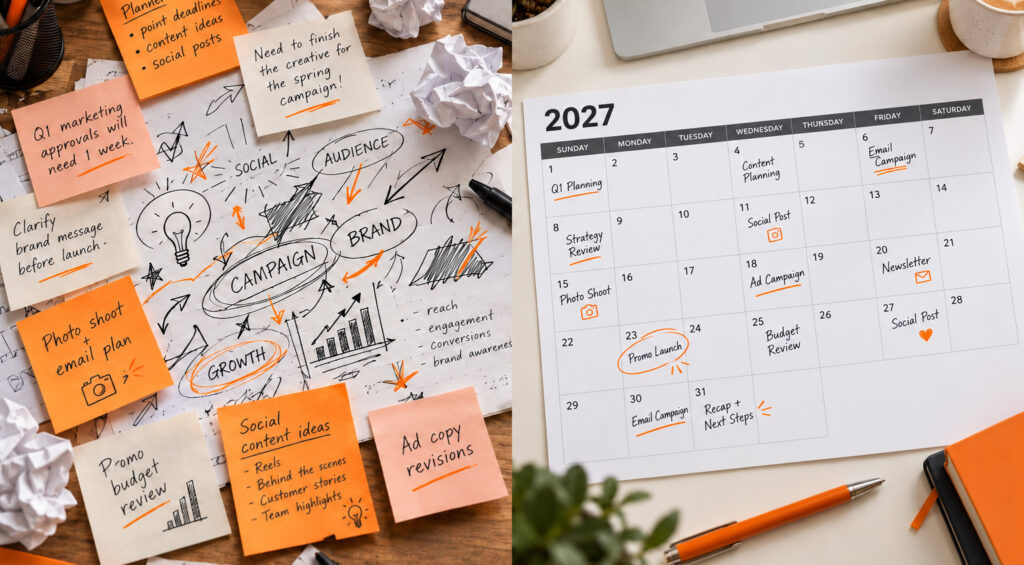
2. Build a 12-month calendar.
Not a wish list — an actual month-by-month view of what runs, when, and why.
- Which campaigns support which goals
- When the seasonal moments hit your industry
- Where photo and video shoots need to land
- What budget sits in which month
- Which quarters need extra air cover
A calendar turns “we should do more email” into “email campaign launches March 3, tied to the Q2 revenue goal, $2,400 budget.” That’s a plan. The first version doesn’t have to be perfect — it just has to be written down.

3. Decide what stays in-house and what gets a partner.
This is the conversation most owners put off, usually because it feels bigger than it needs to.
Here’s the real question: do you have someone on your team who can stay on top of how fast digital marketing is moving right now? Not just run your social and keep the website current — someone tracking Google and Meta algorithm changes, watching what AI is doing to search, learning new ad formats as they roll out, and adjusting what you’re running before it stops working.
For a lot of small businesses, the honest answer is no — and not because the team isn’t sharp. Staying current in digital is close to a full-time job on its own. Platforms change more in a quarter now than they used to in a year.
The right split is rarely “do it all ourselves” or “outsource everything.” It’s an honest look at where your team is strong, where the pace is getting ahead of them, and where a partner would do the most good.
Why planning beats reacting.
Reactive marketing costs more and produces less. Rushed campaigns underperform, media bought at the last minute runs expensive, and the people doing the work burn out. Planning ahead buys you better rates, earlier creative, and a real shot at seasonal moments instead of chasing them.
The businesses that grow in 2027 won’t be the ones trying harder in January. They’ll be the ones who already knew in October what the next twelve months were going to look like.
QUICK WIN
Do this in under 15 minutes.
Open your calendar. Block one 60-minute 2027 planning session this week. Protecting the time is the hardest part, so do it before you close this email.
Up next in December: The year-end marketing audit. What worked, what didn’t, and what to stop paying for in 2027.
Let’s build your 2027 plan.
A working session with ITMG.
Not a sales pitch. Every partnership we run looks a little different, and this is where we figure out what yours should look like.
Previous Article
Meta for Business: Three Tools, One Confusing Name.